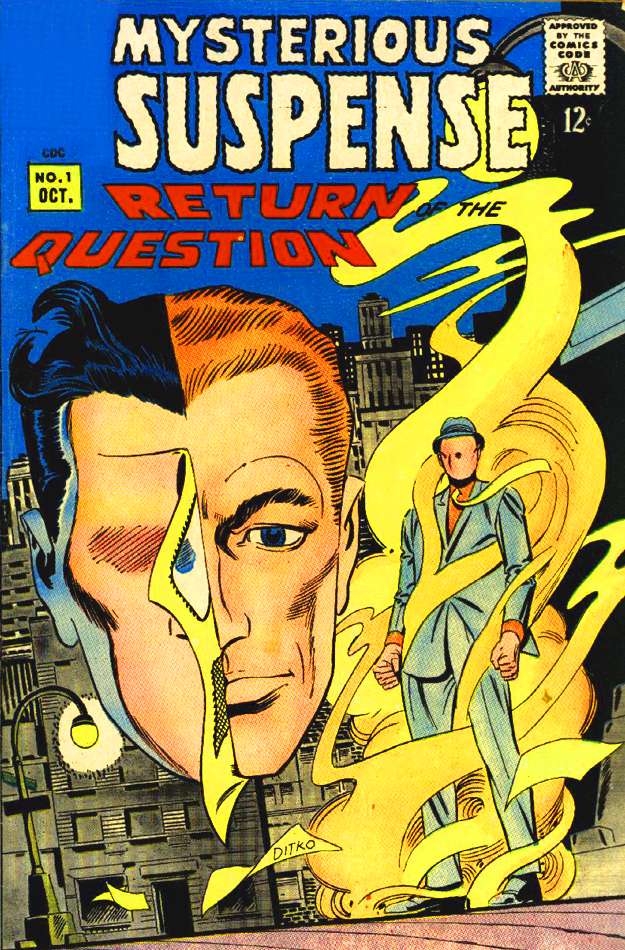
The Question (ingles)
Steve Ditko
Editorial:
Sinopis
Vic Sage era un respetado periodista en un canal de televisión de Hub City.
Durante una investigación, Sage se reencontró con su antiguo profesor, el científico Aristotle Rodor, que le contó sobre una piel artificial que él había co-desarrollado en conjunto con el Dr. Arby Twain, llamada Pseudoderm. Este compuesto había sido ideado para trabajar como una nueva piel, aplicado como si fuera un vendaje con la ayuda de un gas de la vinculación. Sin embargo poseía un imprevisto grado de toxicidad que llegaba incluso a ser fatal cuando era aplicada sobre las heridas abiertas. Rodor y Twain acordaron abandonar el proyecto para luego seguir cada cual su propio camino.
Tiempo después, el profesor Rodor descubrió que el Dr. Twain había decidido iniciar la venta ilegal del Pseudoderm a varias naciones del tercer mundo, sin importarle el riesgo que ello acarreaba para la salud humana.
Sage resolvió detenerlo, pero no tenía ninguna manera de ir tras el Dr. Twain sin exponerse. Ante ello, Rodor sugirió que Vic Sage utilizara una máscara hecha de Pseudoderm para cubrir sus famosos rasgos. Armado con la información, y aún más importante, con un disfraz, Sage eventualmente atrapó al Dr. Twain, deteniendo la transacción y extrayéndole una confesión, e incluso, en un irónico giro del destino, dejándole cubierto en Pseudoderm.
En televisión, Sage difundió un reportaje sobre las actividades ilegales del Dr. Twain.
Sage decidió que esta nueva identidad podría serle muy útil para investigaciones futuras, aliándose de esta manera con el profesor Rodor como proveedor de Pseudoderm, quien eventualmente modificó el gas vinculante para que cambiara el color del cabello e incluso el de la ropa de Sage. Con el tiempo, ambos se hicieron buenos amigos, con Sage refiriéndose cariñosamente a Rodor como “Tot”.
Steve Ditko
Biografía
Ditko studied in the Cartoonist and Illustrators School in New York with Jerry Robinson and he started to work professionally in 1953. His first works were in a little company known as Charlton Comics where he produced science-fiction, horror and mystery stories. Ditko then started to work in what would end up being Marvel Comics.
He collaborated in the creation of characters such as Spider Man and Doctor Strange for Marvel. His idiosyncratic style of drawing, accentuating mood and anxiety, was well received among his readers. The character of Spider Man, with his angst, his anxiety and his busy social life showcased Ditko’s personal style and the interests that Marvel ended up being grateful for. Ditko was a co-writer in the latest stretch of his career. After a four year career with this title, Ditko left the company.
He returned to Charlton were he created some titles such as Captain Atomo, Blue Beetle, Mr. A and The Question. In the pages of Mr. A and The Question, Ditko started to infuse his own philosophy, which had its roots in Ayn Rand’s objectivism.
In 1968, Ditko was creating for DC Comics where he came up with characters such as The Creeper, the Hawk and the Dove. Ditko used these characters, the superhero genre, to present and explore several ethical issues. However, since several readers found the sermons in these unbearable stories, or perhaps because they did not agree with the author’s philosophy, Ditko’s work wasn’t as popular as before. His work lost regularity in DC during the seventies, when he created a short lived story called “Shade, the Changing Man” which was brought back to the light several years after without Ditko’s intervention.
The name of the character Mr. A has its origin in the philosophic Aristotelian principle of identity (“A is equal to A”). This principle is also basic in objectivism (the philosophical system created by Ayn Rand), since objectivism is a development of the philosophical premises created by Aristotle. Mr. A is a character who is entirely dressed in white and has total moral integrity (the same integrity demanded by objectivism).
On July 6th, 2018, the New York Police Department announced that on June 29th, they had found Ditko’s lifeless body in his apartment in Manhattan, New York, although according to what they confirmed to The Hollywood Reporter, he could have died two days before that, on June 27th. It was determined he died due to a cardiac condition.
