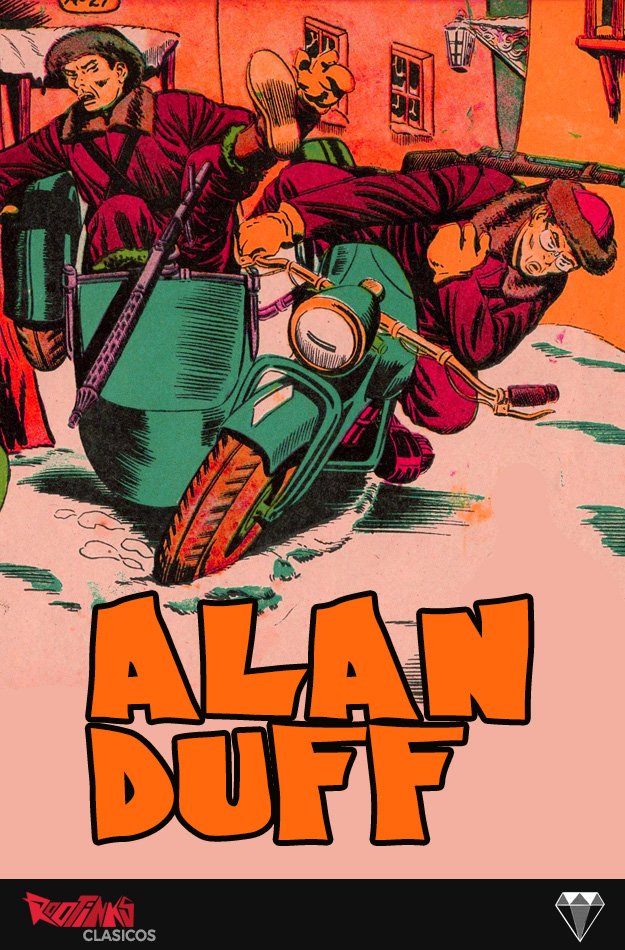
Alan Duff 9
Julio Vivas
Editorial:
Sinopis
Alan Duff fue una serie de 30 cuadernos de aventuras creada por Julio Vivas y publicada por la editorial barcelonesa Marco en 1952.1 Fue el primer tebeo español en el que se trató el mundo del espionaje, aunque de forma esporádica. Luego vendrían Tras el telón de acero (1954), la segunda serie de Kit Boy (1958) y Espionaje (1965).
Comienza con Alan Duff investigando el atropello que ha costado la vida a su amigo, el Dr. Marley. Localiza al conductor y lo pone bajo vigilancia. En un bar frecuentado por el conductor simila una trifulca con un policía para infiltrarse en su banda. Descubre entonces que el Dr. Marley fue asesinado tras curar al jefe de la banda, para evitar que revelase nada.

Julio Vivas
Biografía
"Born in Barcelona (1923), Julio Vivas García is one of the most prolific, forgotten and almost dismissed authors when writing the comic book history of Spain because he is in that artisan category, he is one of those names who bore in quality and high graphic and narrative quality level the weight of a great production for the most part of four decades, from the fifties to the eighties.
His name is associated with his ongoing support of the Hazañas Bélicas in 1950, under Boixcar or Longaron. From there he moved to the female genre, the humour genre and the adventure notebook. His name appears in Merche, Hipo, Monito y Fifí and La Risa. He contributed to ""Alan Duff"", ""El Trío del Aire"" and ""Jim Graves"" or the saga ""El tesoro del pirata"" for the Aventureros del Mundo line, ongoing collections but with a very personal style published by Toray in the fifties, a house in which he left some very special contributions to the female comic which would later serve him -in 1959-1961- from magazine Can Can by Burguera to contribute his jokes with the famous ""Vivas' girls"". Although most of his work has never been published in our country, during certain times in which he was very busy he illustrated up to four pages a day, some that were never inked in, as he said in a telephone conversation... the work of Julio Vivas has a dignity and a natural sense of narration with a perfect economy of means and rough setting capable of prevailing through time.
And all this without mentioning hundreds of police, adventure and science fiction self-conclusive stories in the special publications of Editorial Bruguera, such as Super Pulgarcito, Super Mortadelo, Mortadelo Especial... and several Extras and Almanacs.
This is why we remember a name we must never forget, Julio Vivas García, a tital of he realistic Spanish comic, even though in his beginnings he dabbled with the semi-cartoon style.
Apparently, Julio Vivas García passed away in Barcelona in June, 2017 at 94 years old. "
